GR 106 Calligraphy
Slide Show 3
-
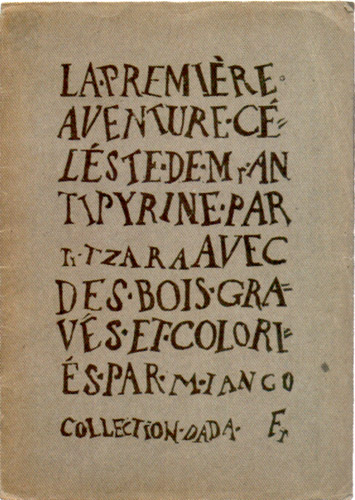
 Marcel Janco - Book Cover
Zurich, 1916
Woodcut - The First Celestial Adventure of Mr. Antipyrine by Tristan Tzara with color and woodcuts by Marcel Janco. Collection Dada
Freedom from convention of typography is shown in the irregular axis, stem width, and spontaneous shaping of interlinear space and hand drawn letters. In terms of design contrast, the title is differentiated in size from the author and designer and publisher.
Tristan Tzara published this book, the first of the Dad publications. To understand dada you can read the English translation of his 1918 "Dada Manifesto" here.
-
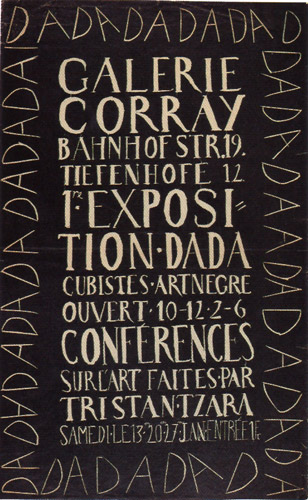
 Marcel Janco - Poster for First Dada Exposition
Zurich, 1917
Linoleum cut - 16.75 x 10.375
Marcel Janco was a painter who excelled in the new media. His use of repeated letterform as a border for the main text exploits the contrast and rhythms of black and white format. Note the extra D in upper right corner that "doesn't fit" but is used to fill the space.
-
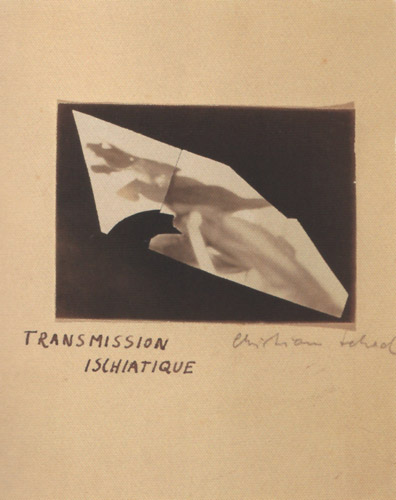
 Christian Schad - Tranmission Ischiatique [Schadograph no. 5]
Zurich, 1919
Photogram: gelatin silver printing-out paper print - 2.375 x 3.25
Hand-lettered titling was informal, spontaneous, and without pretention.
A photogram is a photographic image made (without a camera) by placing objects directly onto the surface of a photo-sensitive material such as photographic paper and then exposing it to light. The result is a silhouetted image varying in darkness based on the transparency of the objects used, with areas of the paper that have not received any light appearing light and those that have appearing dark, according to the laws of photosensitivity. The image obtained is hence a negative and the effect is often quite similar to an X-Ray. This method of imaging is perhaps most prominently attributed to Man Ray and his exploration of rayographs. Others who have experimented with the technique include Lazlo Moholy-Nagy, Imogen Cunningham and even Pablo Picasso.
-
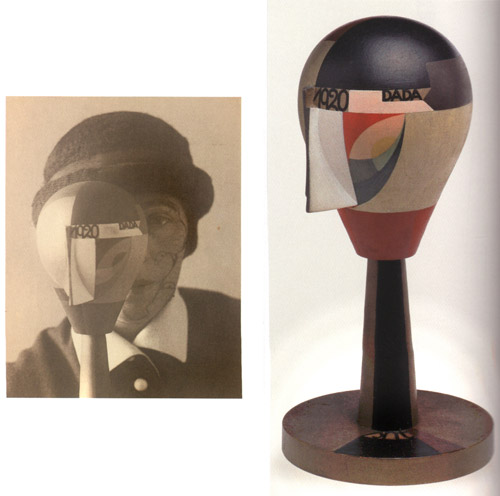
 Sophie Taeuber - Untitled (Dada Head)
Zurich, 1920
Oil on turned wood - 11-9/16 inches tall
Sophie Taeuber was a teacher at the Zurich School of Applied Arts and had early freed herself from the distinctions between painting and decorative arts. She was skilled in woodworking, weaving, embroidery, and other aspects of arts and crafts.
The image on the right is a constructed and painted mannikin head. Taeuber was a skilled maker of puppet figures made of wood, metal and fabric for the Swiss Marionette Theatre and this Dada Head drew from that skill. Note the artist's initials SNT on the base above the black shape.
The image on the left is Taeuber's Self Portrait with Dada-Kopf, a photograph taken by Nic Aluf in 1926; this gelatin silver print is in the collection of the San Francisco Museum of Modern Art. Taeuber met Hans Arp in 1915 during Arp's first exhibit in Zurich and as partners the two pursued a re-formation of aesthetic ideology which employed three-dimensional abstraction and symmetry, in direct opposition to the two-dimensional and asymmetrical compositions of times past. The edges between painting and craft began to blur as she wove large embroideries to frame and hang on the wall, and Arp began to sculpt flat woodworked relief images to hang as well.
-
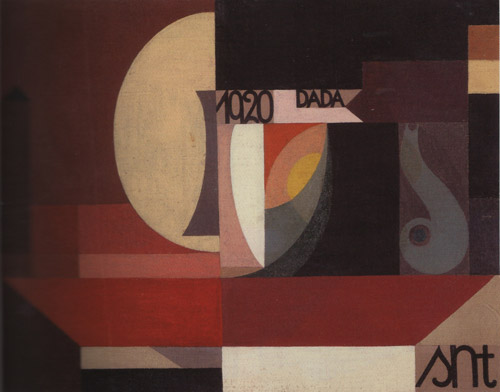
 Sophie Taeuber - Untitled (Composition Dada, Flat Head)
Zurich, 1920
Oil on canvas on board - 13.75 x 16.25
The creation of the previous mannikin head is here translated onto a flat plane, its components separated and brought together in a new composition. The transition from observing and analyzing the visual world to observing and analyzing the created object/moment is complete.
-
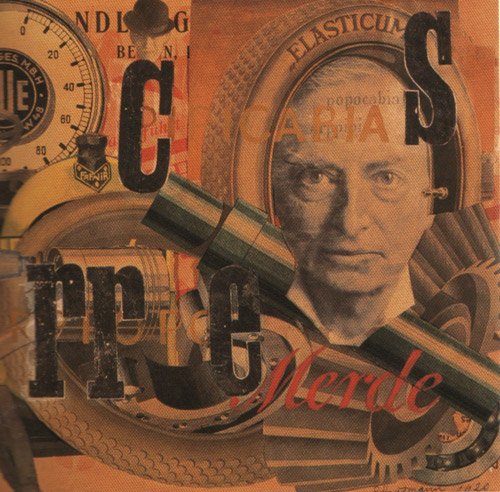
 Raoul Hausmann - Elasticum
Berlin, 1920
Photomontage and collage with gouache on the cover of the exhibition catalogue of the First International Dada Fair - 12.25 x 14. 5
Choosing, arranging, and placing elements from every day life in layers reflected more clearly the succession of moments and realities of life in increasingly complex times. Compositional rules of balance, color harmony, aerial perspective were not ignored, but used in new ways with new elements. Nothing was taboo if the statement succeeded.
-
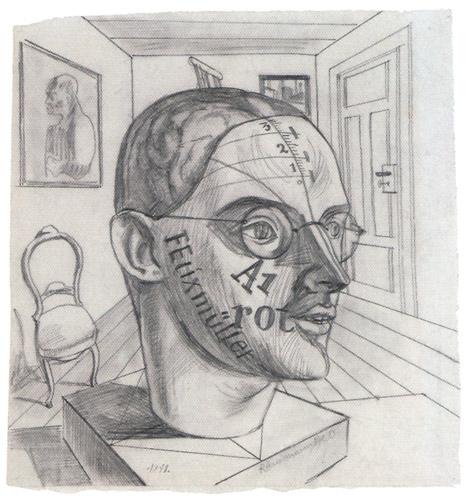
 Raoul Hausmann - Portrait of Conrad Felixmüller as a Mechanical HEad
Berlin, 1920
Pencil on Paper - 14.25 x 13.5
Excellent draftsmanship combined with the embracing of letterform as object, using the letters and numerals to delineate the planes and volumes of the head. Word images were integral to Dadaist art.
-
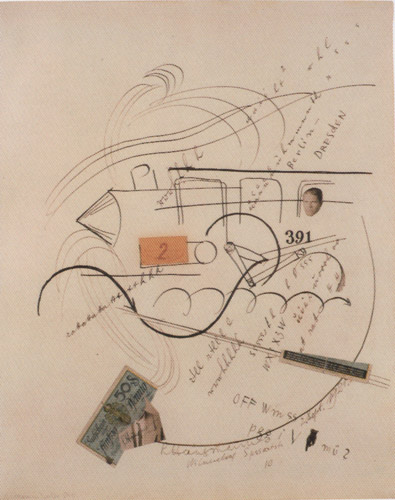
 Raoul Hausmann - 391 Berlin-Dresden
Berlin, 1921
Ink on paper with photomontage and collage - 17.125 x 13.75
The act of traveling by train is illustrated in a collage drawing that glimpses in visual shorthand the engine, engine number, smoke, passenger, written sounds, ticket, stamp, destination, tracks, movement of wheel mechanisms, all of the elements that make up a memory of that 391 Berlin-Dresden train ride.
-
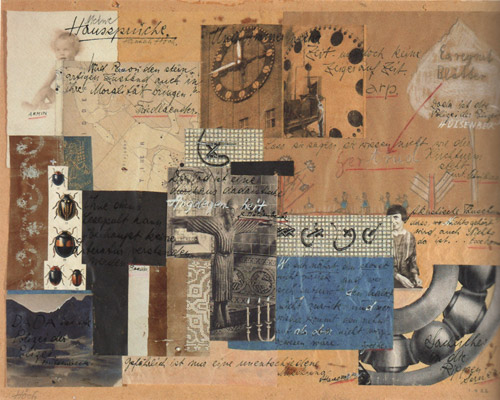
 Hannah Hoch - Proverbs to Live By
Berlin, 1922
Photomontage and collage with ink, zinc white, graphite, crayon, and colored pencil on board - 12.625 x 16.25
A scrapbook of experience combining diverse media provide a wide look into the artist's psyche, personality, contemporary surroundings, and life history. Personal and impersonal are combined.
-
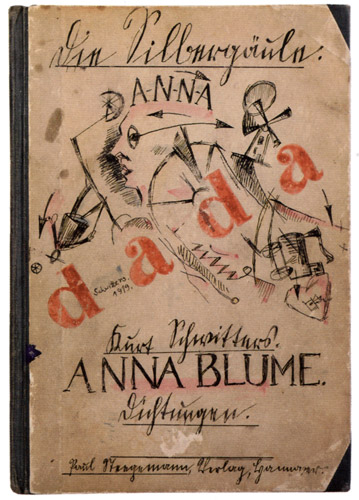
 Kurt Schwitters - Cover of the illustrated book: Anna Blume, Poems
Hannover, 1919
Ink and watercolor on paper mounted on book cloth - 8.75 x 5.75
Raw sketching, spontaneous with no artifice. Letterforms are built up following typographical models. Gothic heritage can be seen in the stylized roundhand script. There is concern always with spacing and rhythm, but there is absolute acceptance of what comes out first, without much attention to the rough draft stage. The art unfolds organically.
-
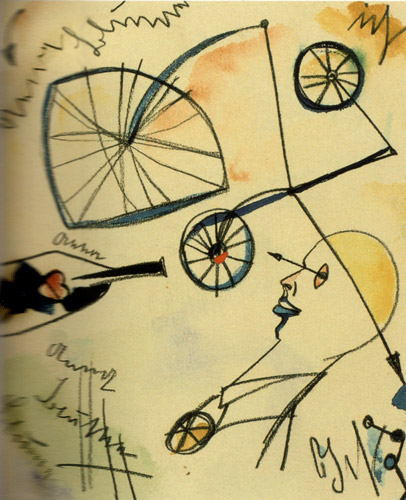
 Kurt Schwitters - Anna Blume and I
Watercolor and colored pencil on paper mounted on book cloth - 8.325 x 6.75
Here the scribbled letterforms are very rough, but certainly present. Letterform was integral to dadaist art, signifying the spoken word. The title refers to his famous poem "An Anna Blume" translated as "Eve Blossom." You can read the text here or research Schwitters on the web. This poem is written Dada art, full of non-sequitur and unexpected syntax.
-
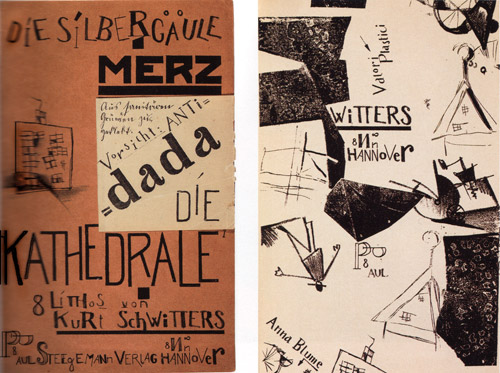
 Kurt Schwitters - Cover and title page of the book: Kathedral
Hannover, 1920
Two lithographs, one with collage - 8.75 x 5.75
Here the letterforms are built up again from typographic models, and scattered throughout the visual field with a conviction that their placement is correct and intended, though spontaneous. Schwitters was the proponent of "Merz" art, his innovative assemblages and collages. All conceivable materials and images were available for artistic purposes. The artist creates through choice, distribution and dematerialization of the materials.
-
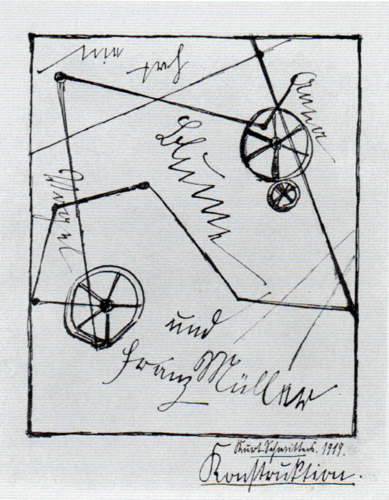
 Kurt Schwitters - Konstruction
Hannover, 1919
Ink on paper - 8.75 x 5.75
This simple drawing shows the relationship between speech and image; in a sense they are the same on paper: tools for constructing a work of art that conveys realization.
-
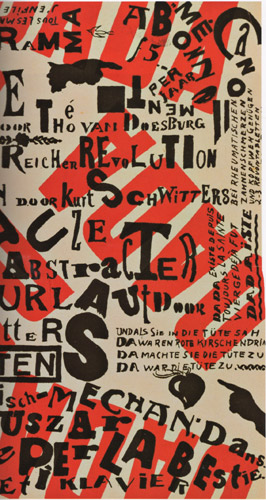
 Kurt Schwitters - Poster and Program for Small Dada Evening
Hannover, 1922-23
Lithograph (detail) - full size: 11.825 x 11.825
All hand drawn letters, balanced and mixing in the visual field with a careful management of the placement. There is almost a whorl creating a centrifugal effect, carried out by the angular placement of the words DADA and the outward orientation of the small text. This detail is the right side of the program only.
-
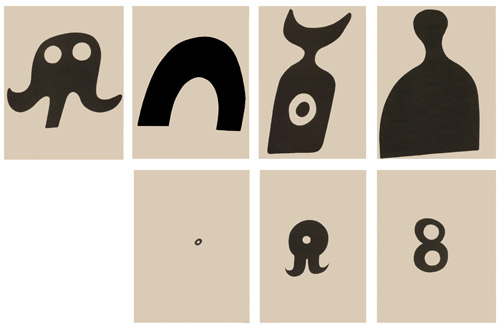
 Hans Arp - Arp Portfolio: Seven Arpades
Hannover, 1923
Seven lithographs on paper - each sheet is 17.75 x 13.75
From left to right the titles are: Mustache Hat, The Sea, The Navel Bottle, Eggbeater, A Navel, Mustache Watch, Arabic Eight
The form is the message. Look at these in the light of Notan and see how well they work in terms of black/white balance. There is no background. There is implication of distance through the placement of these "simple" two dimensional forms. Does the black recede, or is the white more distant? It is important to grasp this ambiguity.
-
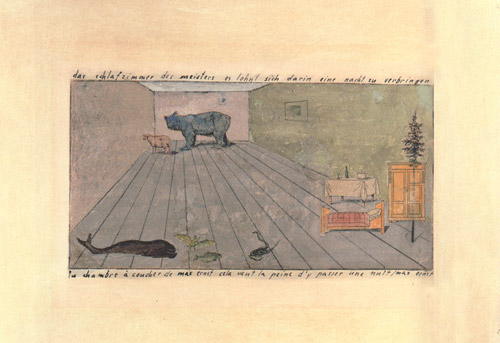
 Max Ernst - The Master's Bedroom
Cologne, 1920
Gouache, pencil and ink on printed preproduction
mounted on board with ink inscription - 6.825 x 8.75Complete title reads: In German, "The master's bedroom, it's worth spending a night there", and on the bottom in French, "Max Ernst's bedroom, this is worth the trouble of passing the night".
How can one destroy art? By doing the opposite of the past and consciously rebelling against all "rules," the dadaists attempted to ridicule and reject established aesthetics. Images were drawn from within, from the wealth of the subconscious, pointing more and more toward surrealism.
-
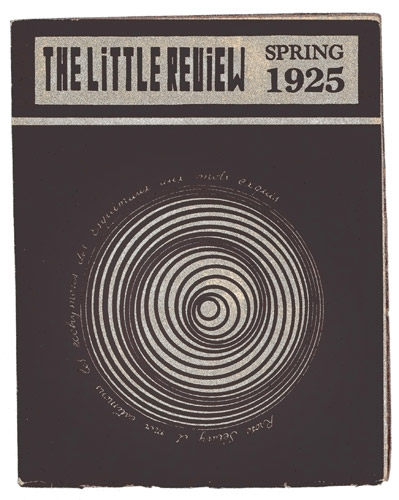
 Marcel Duchamp / Man Ray - Book CoverNew York, 1925
Paperback Book Cover reproducing white gouache on black paper drawing - 9.75 x 7.5
Project for the Rotary Demisphere, cover of the journal The Little Review, vol. 11, no. 1, Spring 1925
Text that runs around circle is an elaborate play on words: "Rrose Sélavy et moi estimons les ecchymoses des Esquimaux aux mots exquis." (Rrose Sélavy and I esteem the bruises of the Eskimos as exquisite words) From Wikipedia, "Rrose Sélavy, a pun, sounds like the French phrase 'Eros, c'est la vie', which translates to English as 'love, that's life'."
-
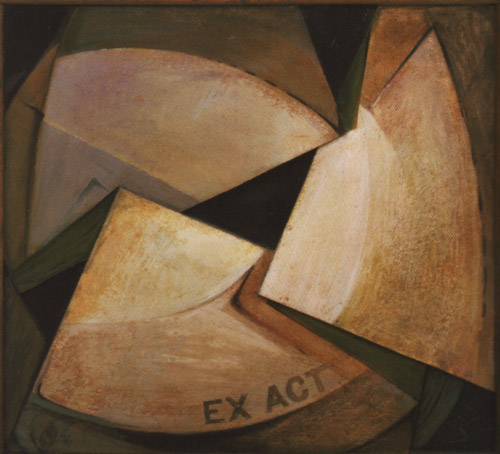
 Jean Covert - Ex Act
New York, 1919
Oil on plywood and board - 20.25 x 25.25
The lettering describes this composition which is based on the form of X.
-
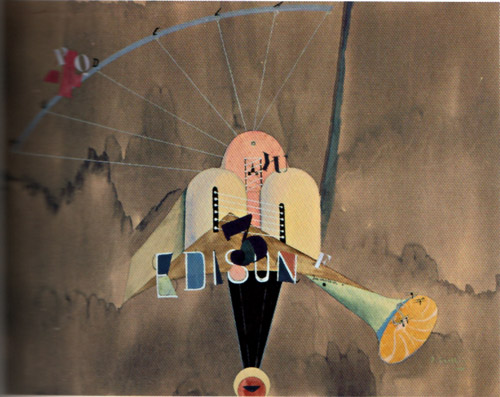
 Jean Crotti - Portrait of Edison
Paris, 1920
Gouache, watercolor and pencil on paper - 19.25 x 25.325
Homage to Thomas Edison with images symbolic of broadcasting sound (numerals, words, music notes). The word "audela" upper left means "beyond".
-
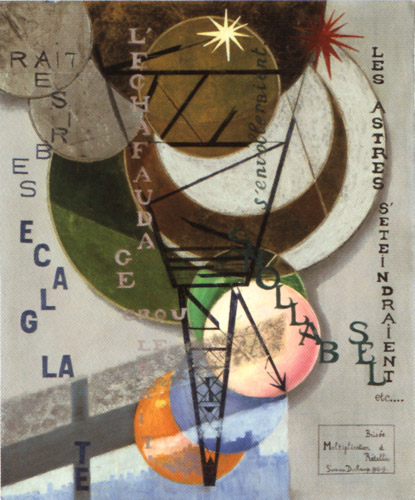
 Suzanne Duchamp - Broken and Restored Multiplication
Paris, 1918-19
Oil and collage of silver paper on canvas - 24 x 19.75
Some words contained herein are: "Et la glace se briserait" (and the ice will break up), "L'echauffage croulerait" (warmth will rock), "Les ballons s'envolleraient" (balloons, spheres will fly away), "Les astres s'eteindraient" (the stars will be extinguished), etc.
-
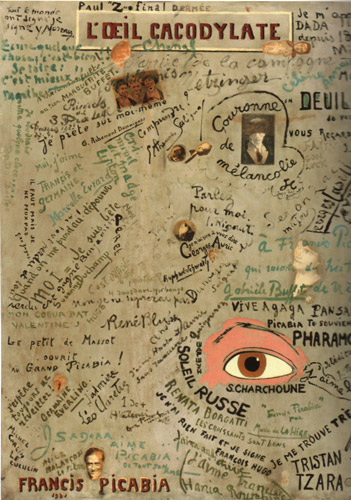
 Francis Picabia - The Cacodylic Eye
Paris, 1921
Oil with photomontage and collage on canvas - 58.5 x 46.25
This handwritten collection of famous dadaist signatures and phrases is a record of humor, moments shared, impressions of friends, awareness of present, created by Picaba and signed by the individuals as a memory book. Many types of writing are used.
Cacodyle: a colorless, poisonous, arsenical liquid, spontaneously inflammable and possessing an intensely disagreeable odor.
-
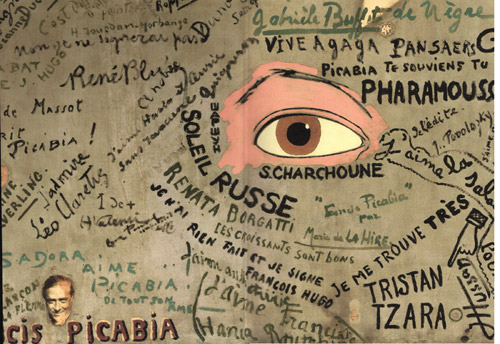
 Francis Picabia - The Cacodylic Eye (Detail of previous image)
Paris, 1921
Oil with photomontage and collage on canvas - 58.5 x 46.25
Closeup of detail.
-
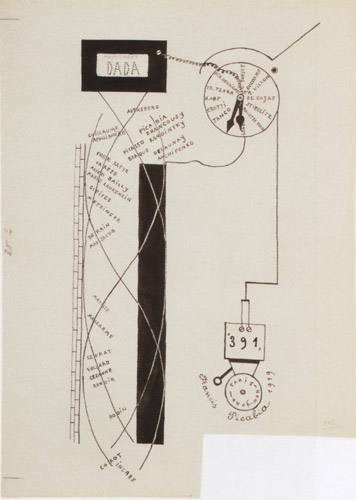
 Francis Picabia - Mouvement Dada
Paris, 1919
Ink on paper - 20.125 x 14.25
A visual plotting of the movement of dada, with a timeline mentioning all those who were involved and contributed to the movement. There is a reference to "391", the Berlin-Dresden train that Hausmann portrayed two years later. The imagery calls to mind a time-bomb, darkly humorous.
-
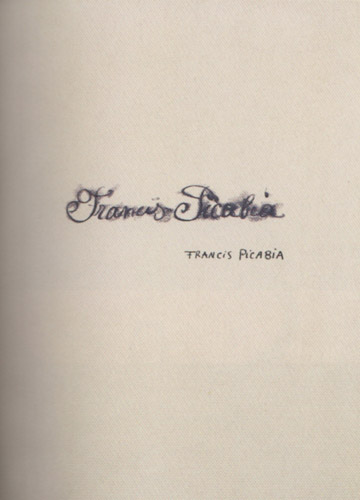
 Francis Picabia - Self-Portrait
Paris, 1920-22
Ink and watercolor on paper - 12.75 x 11
What is in a name? Why not a self portrait as signature, the graphic representation of the person by what they are called, complete with smudges and imperfections?
-
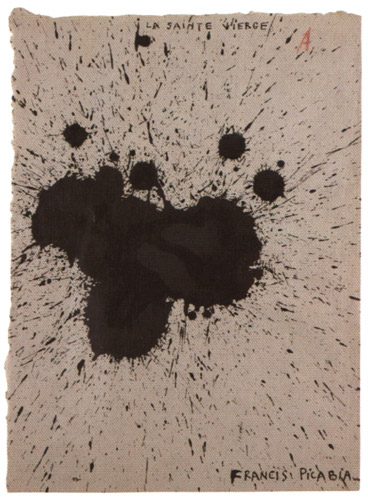
 Francis Picabia - The Virgin Saint II
Paris, 1920
Pencil and ink on paper - 12.625 x 9.125
Here there is a correlation established between the title, Virgin Saint or Blessed Virgin, and the dynamic ink splash. Can you figure out the connection? If so, you will have entered the mind of Francis Picabia.
-
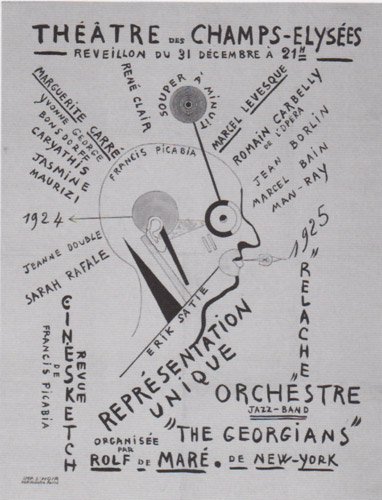
 Francis Picabia - Poster for Cinésketch Gala
Lithograph with watercolor - dimensions not available
As the Dada Movement nears the end of its flourishing before moving forward into new forms, it is represented by Picabia's poster for a Year's Eve event which includes an routine that furthers the interplay between staged and filmed reality. Called Cinésketch, it was a ballet that features intertitles announced loudly through a megaphone; the lights are switched on and off with the action in imitation of cinematic scenes. Duchamp and a young woman appear briefly at one point as Adam and Eve, modeled after Lucas Cranach. The narrator cries out as the stage goes dark: "The policeman, who doesn't understand, wants to arrest everybody."
Dada art did not occur in a vacuum. It was part of the art community, the social fabric of the time, and was inseparable from current events. It was not sentimental nor did it copy. It was educated, experiential, fearless and sardonic, loud and filled with energy and a strong desire for using an ever-increasing range of expression, means, and methods.
I hope this slide show gives you a good view of this very exciting as well as troubled time, when artists came together to express outrage and discontent as well as vitality, warmth and appreciation of life. What has changed in 90 years?